


The Giza Pyramids are among the most recognizable monuments in the world and one of the most important archaeological sites in Egypt. Located on the Giza Plateau, just outside modern Cairo, the pyramids have fascinated travelers, historians, archaeologists, and explorers for thousands of years.
For many visitors, seeing the Pyramids of Giza for the first time is the highlight of an Egypt vacation. The enormous size of the monuments, their ancient history, the surrounding desert landscape, and the nearby Great Sphinx create an experience that is difficult to compare with any other destination.
The Giza Plateau is home to three major pyramids: the Great Pyramid of Giza, built for Pharaoh Khufu; the Pyramid of Khafre, built for Pharaoh Khafre; and the Pyramid of Menkaure, built for Pharaoh Menkaure. Together, these monuments form one of the most remarkable archaeological landscapes ever created.
This complete guide explains everything you need to know about visiting the Giza Pyramids, including their history, construction, the Great Sphinx, the best time to visit, what to see, how long to spend there, ticket information, photography opportunities, camel rides, private tours, and practical advice for first-time visitors.
Where Are the Giza Pyramids?
The Giza Pyramids are located on the Giza Plateau in Giza, Egypt, on the western side of the Nile River and approximately 15 kilometers from central Cairo.
The location makes the pyramids relatively easy to reach from many parts of Cairo and Giza. Depending on traffic and your starting point, the drive can take anywhere from around 30 minutes to more than an hour.
The Giza Plateau includes much more than the three famous pyramids. The archaeological area contains temples, tombs, smaller pyramids, causeways, cemeteries, workers’ settlements, and the famous Great Sphinx.
The area is also close to the Grand Egyptian Museum, making it possible for travelers to combine a visit to the pyramids with a museum experience on the same day.
For travelers staying in Cairo, Giza, or near the pyramids, visiting the plateau is usually one of the first activities to include in an Egypt itinerary.
The History of the Giza Pyramids
The pyramids at Giza were constructed during Egypt’s Fourth Dynasty, approximately 4,500 years ago.
This period is often described as the height of ancient Egyptian pyramid building. Egyptian civilization had already developed sophisticated systems of administration, engineering, agriculture, mathematics, religion, and architecture.
The rulers of the Fourth Dynasty used monumental construction projects to create royal burial complexes that reflected their power and religious beliefs.
The three major pyramids at Giza were built for three successive pharaohs:
- Khufu
- Khafre
- Menkaure
Although the pyramids were primarily royal funerary monuments, they were part of much larger complexes containing temples, causeways, smaller pyramids, tombs, and other structures.
The construction of these complexes required enormous amounts of stone, organized labor, transportation systems, food supplies, skilled craftsmen, engineers, architects, and administrators.
The result was a landscape that has survived for more than four millennia.
The Great Pyramid of Giza
The Great Pyramid of Giza is the largest of the three pyramids and the most famous.
It was constructed for Pharaoh Khufu, who ruled Egypt during the Fourth Dynasty.
The Great Pyramid was originally approximately 146.6 meters high. Over thousands of years, erosion, earthquakes, and the loss of its outer casing stones reduced its current height to around 138.5 meters.
The pyramid was originally covered with smooth white limestone casing stones that would have created a highly polished surface.
When sunlight struck the limestone, the pyramid would have appeared very different from what visitors see today.
The Great Pyramid was the tallest human-made structure in the world for thousands of years, until medieval European structures eventually surpassed it.
Its enormous size remains one of the most impressive examples of ancient engineering.
Who Built the Great Pyramid?
One of the most common myths about the Giza Pyramids is that they were built by slaves.
Modern archaeological evidence provides a more complicated and fascinating picture.
Archaeologists have discovered evidence of organized communities of workers near the Giza Plateau. These workers included skilled craftsmen, laborers, administrators, and support workers.
Evidence suggests that the pyramid-building workforce was organized and supplied with food, housing, medical care, and other necessities.
This does not mean that construction was easy. Building the Great Pyramid was an enormous undertaking that required generations of planning and immense physical effort.
The workers needed to quarry limestone, transport massive stones, shape them, position them, and construct the pyramid layer by layer.
How Were the Giza Pyramids Built?
The construction of the pyramids remains one of the most fascinating subjects in ancient Egyptian history.
The Egyptians did not have modern cranes, engines, trucks, or advanced machinery. Yet they successfully constructed enormous stone monuments with remarkable precision.
Historians and archaeologists continue to study exactly how the pyramids were constructed.
Most theories involve combinations of ramps, sledges, levers, ropes, manpower, and carefully organized transportation systems.
Large blocks were quarried and transported from different locations.
Some limestone came from local quarries, while higher-quality limestone used for important sections came from Tura, across the Nile.
Granite used in parts of the internal chambers of the Great Pyramid was transported from Aswan, hundreds of kilometers south of Giza.
The transportation of these materials demonstrates the sophistication of ancient Egyptian logistics.
The Pyramid of Khafre
The second major pyramid at Giza was built for Pharaoh Khafre.
The Pyramid of Khafre is immediately recognizable because it still retains some of its original casing stones near the top.
This remaining limestone cap provides visitors with a glimpse of how the pyramids may have looked when they were newly constructed.
Although the Pyramid of Khafre appears taller than the Great Pyramid from certain viewpoints, this is largely because it was built on higher ground.
Its original height was approximately 143.5 meters.
The pyramid complex also has a strong connection to the Great Sphinx.
Many historians associate the Great Sphinx with Khafre’s pyramid complex, although some aspects of its exact history remain subjects of scholarly discussion.
The Pyramid of Menkaure
The smallest of the three main pyramids is the Pyramid of Menkaure.
It was built for Pharaoh Menkaure and originally stood approximately 65 meters high.
Although it is significantly smaller than the Great Pyramid, its construction demonstrates the same impressive engineering tradition.
The lower sections of the pyramid contain granite, a much harder stone than limestone.
The use of granite presented additional challenges for ancient builders because it had to be quarried, transported, shaped, and positioned with remarkable accuracy.
The Menkaure complex also included temples and smaller pyramids associated with royal burials.
The Great Sphinx of Giza
No visit to the Giza Pyramids is complete without seeing the Great Sphinx.
The Great Sphinx is a monumental limestone statue with the body of a lion and the head of a human.
It is one of the most recognizable sculptures in the world.
The Sphinx measures approximately 73 meters long and stands around 20 meters high.
Its face is traditionally associated with Pharaoh Khafre, although scholars have debated various aspects of the monument’s identity, date, and original purpose.
The lion’s body may symbolize strength and royal power, while the human head represents the pharaoh.
The Sphinx has suffered from erosion and damage over thousands of years and has undergone numerous restoration projects.
Despite its age, it remains one of the most impressive monuments on the Giza Plateau.
Why Is the Great Sphinx Missing Its Nose?
One of the most common questions visitors ask is what happened to the Sphinx’s nose.
Contrary to popular legend, there is no reliable evidence that Napoleon’s soldiers destroyed the nose.
Historical drawings and descriptions indicate that the Sphinx was already missing its nose before Napoleon’s campaign in Egypt.
The exact circumstances surrounding the damage remain uncertain.
Over the centuries, the Sphinx was exposed to natural erosion, weathering, sand, and human activity.
The missing nose has therefore become one of the most famous mysteries associated with the monument.
What Can You See at the Giza Pyramids?
A visit to the Giza Plateau can include much more than simply seeing the three pyramids from a distance.
Depending on your ticket and tour, you may explore several important areas.
The Great Pyramid
The Great Pyramid is the primary attraction on the plateau and the largest pyramid in Egypt.
Visitors can admire its exterior or, with the appropriate ticket, enter its internal passages and chambers.
Pyramid of Khafre
The second pyramid provides excellent photography opportunities, especially because of the surviving casing stones near its summit.
Pyramid of Menkaure
The smallest of the three major pyramids offers another perspective on royal pyramid construction.
Great Sphinx
The Sphinx is located near the pyramids and is one of the most important monuments to include in your itinerary.
Valley Temples
The pyramid complexes include ancient temples associated with the burial and religious ceremonies of the pharaohs.
Smaller Pyramids
Several smaller pyramids were constructed for queens and other members of the royal family.
Ancient Cemeteries
The plateau contains numerous tombs belonging to officials, nobles, and people connected with the royal administration.
Can You Go Inside the Great Pyramid?
Yes, visitors can enter the Great Pyramid with the appropriate ticket.
However, entering the pyramid is very different from viewing it from outside.
The internal passageways can be narrow, steep, and physically demanding.
Visitors should be prepared for limited space and potentially warm conditions.
Inside the Great Pyramid, visitors can see areas including the Grand Gallery and the King’s Chamber.
The experience is particularly interesting for travelers who want to understand the internal architecture of the monument rather than simply photograph its exterior.
However, not everyone needs to enter the pyramid.
If you are uncomfortable with enclosed spaces, have mobility difficulties, or prefer a more relaxed experience, viewing the pyramid from outside can still be spectacular.
Best Time to Visit the Giza Pyramids
Choosing the right time to visit can significantly improve your experience.
Egypt can become very hot, particularly during the summer months.
For many travelers, early morning is one of the best times to visit the Giza Pyramids.
Morning temperatures are generally more comfortable, and the light can be excellent for photography.
Early arrival also helps you avoid some of the busiest periods.
Another popular option is late afternoon, especially when the sunlight becomes softer and the desert landscape takes on warmer tones.
During the hottest months, visiting as early as possible is strongly recommended.
Visiting the Pyramids at Sunrise
A sunrise visit to the Giza Plateau can be unforgettable.
The desert landscape becomes illuminated gradually as the sun rises, creating dramatic colors around the pyramids.
Early morning also provides a quieter atmosphere compared with the middle of the day.
Travelers interested in photography often prefer sunrise because the light is softer and the shadows create more depth around the monuments.
A sunrise pyramid tour can also be combined with breakfast overlooking the pyramids.
Visiting the Pyramids at Sunset
Sunset is another excellent time for photography.
As the sun moves toward the horizon, the pyramids become surrounded by warm golden light.
The atmosphere can be particularly beautiful from viewpoints overlooking all three pyramids.
Sunset visits are also popular with couples and travelers looking for memorable photographs.
However, opening hours and access rules should always be checked before planning a late visit.
How Long Do You Need at the Giza Pyramids?
A basic visit to the Giza Plateau can take around two to three hours.
However, travelers who want to explore more thoroughly should consider spending three to five hours in the area.
A longer visit allows time for:
- The Great Pyramid
- Pyramid of Khafre
- Pyramid of Menkaure
- Great Sphinx
- Valley Temple
- Photography stops
- Optional camel ride
- Entering a pyramid
- Exploring viewpoints
If you combine Giza with other Cairo attractions, a full-day itinerary may be more appropriate.
For example, you could visit the Giza Pyramids in the morning and continue to the Grand Egyptian Museum, Old Cairo, or Khan el-Khalili later in the day.
Giza Pyramids and the Grand Egyptian Museum
The Grand Egyptian Museum is located near the Giza Plateau and has become an important addition to Cairo’s archaeological tourism landscape.
Combining the Giza Pyramids with the museum can create an excellent full-day experience.
You can begin with the pyramids in the morning and then continue to the museum to learn more about ancient Egyptian civilization and its artifacts.
This combination allows visitors to experience both the monumental architecture of ancient Egypt and the objects associated with its history.
For first-time visitors to Egypt, a Giza and museum itinerary can provide a broad introduction to ancient Egyptian civilization.
Camel Rides at the Giza Pyramids
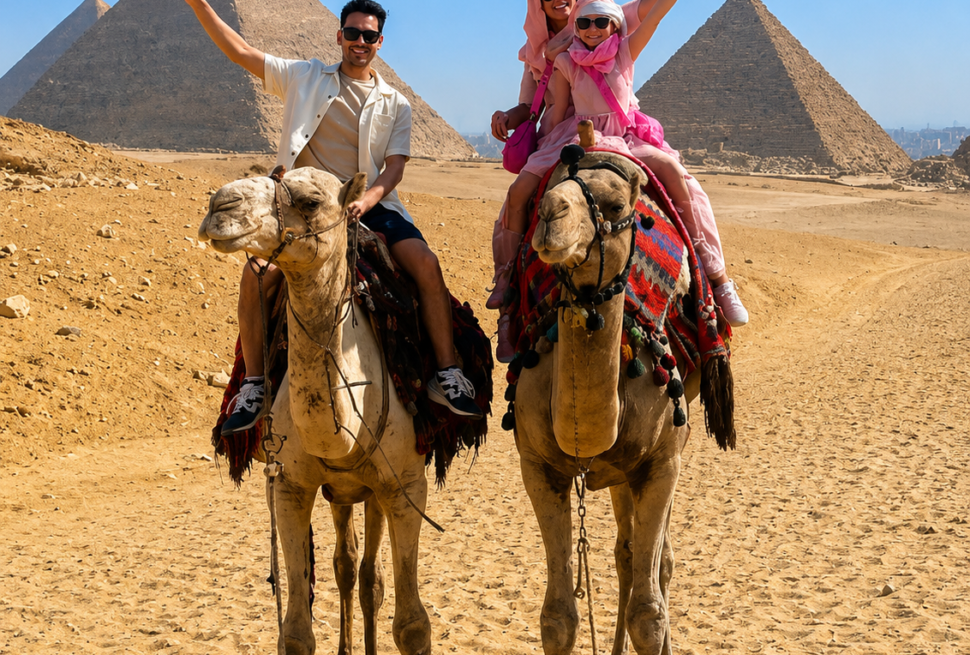
Camel riding is one of the most popular experiences around the pyramids.
From a camel, visitors can enjoy panoramic views of the desert landscape and the pyramids.
Camel rides can range from short photography experiences to longer rides around the plateau.
However, travelers should always clarify the price and duration before beginning a camel ride.
A private tour with a guide can help travelers understand the arrangement and avoid confusion.
Camel rides are particularly popular for photography because they create a classic desert scene with the pyramids in the background.
Photography at the Giza Pyramids
The Giza Plateau offers countless photography opportunities.
Some of the most popular views include:
- The Great Pyramid from the main entrance
- All three pyramids from the western plateau
- The Sphinx with the Great Pyramid behind it
- Camel photographs in the desert
- Sunset photographs
- Sunrise photographs
- Close-up architectural details
The pyramids look dramatically different depending on the time of day.
Morning light can provide crisp details, while afternoon and sunset light can create warmer tones.
If you are taking professional photographs, check current photography rules and any applicable permit requirements before your visit.
What Should You Wear to the Pyramids?
Comfortable clothing is important when visiting the Giza Plateau.
The area involves walking over uneven ground, stone surfaces, and sandy terrain.
Comfortable walking shoes are therefore highly recommended.
During hot weather, lightweight clothing, sunglasses, a hat, and sunscreen are useful.
It is also a good idea to carry water.
The desert environment can feel significantly hotter than the temperature displayed in a weather forecast because of direct sunlight and limited shade.
During winter, mornings can be cooler, so a light jacket may be useful.
What Should You Bring?
For a comfortable visit, consider bringing:
- Water
- Sunglasses
- Sunscreen
- Hat
- Comfortable walking shoes
- Phone or camera
- Portable charger
- Small bag
- Cash for personal expenses
If you plan to spend several hours at the site, staying hydrated is especially important.
How to Get to the Giza Pyramids
There are several ways to reach the Giza Pyramids.
Private Car
A private car is one of the most convenient options, particularly for families and groups.
You can arrange pickup from your hotel and travel directly to the archaeological area.
Taxi
Taxis and ride-hailing services can also be used, although travelers should make sure they understand where the driver will drop them off.
Organized Tour
A guided tour can include transportation, entrance tickets, a professional guide, and additional experiences such as camel riding or lunch.
For first-time visitors, an organized private tour can reduce the logistical challenges of visiting multiple attractions.
Why Choose a Private Giza Pyramids Tour?
A private Giza Pyramids tour gives you much greater flexibility than a large group tour.
You can choose your pickup time, spend longer at attractions that interest you, and adjust the itinerary according to your preferences.
Private tours are particularly useful for:
- Families
- Couples
- Small groups
- Photographers
- Travelers with limited time
- Travelers who want a personalized itinerary
A private Egyptologist guide can also explain the history of the pyramids, Sphinx, temples, and ancient Egyptian civilization.
Giza Pyramids Tour with a Private Guide
A knowledgeable guide can completely change the way you experience the pyramids.
Without a guide, visitors can admire the monuments but may not understand the historical relationships between the pyramids, temples, tombs, and ancient Egyptian beliefs.
A licensed Egyptologist can explain:
- Why pyramids were built
- How royal funerary complexes worked
- How ancient Egyptians organized construction
- The religious beliefs surrounding death
- The role of the pharaoh
- The history of Khufu, Khafre, and Menkaure
- The meaning of the Sphinx
- Ancient Egyptian architecture
This can turn a simple sightseeing visit into a deeper historical experience.
Giza Pyramids Without Shopping Stops
Some travelers specifically prefer a no-shopping tour.
Traditional tours sometimes include visits to commercial establishments selling souvenirs, perfumes, papyrus products, or other items.
If shopping is not part of your travel plans, a private no-shopping itinerary can be a better choice.
You can focus your time on the pyramids, Sphinx, temples, photography, camel riding, lunch, and other attractions that you actually want to experience.
When booking, clearly request a no-shopping itinerary if this is important to you.
Giza Pyramids and Khan el-Khalili
Travelers with a full day in Cairo can combine the pyramids with historic Cairo and Khan el-Khalili.
Khan el-Khalili is one of Cairo’s most famous traditional markets.
After exploring the ancient monuments of Giza, visitors can experience the atmosphere of historic Cairo, browse traditional products, and enjoy Egyptian food or drinks.
A full-day Cairo itinerary can therefore combine ancient monuments with the city’s medieval and modern culture.
Giza Pyramids and Saqqara
Another excellent combination is Giza and Saqqara.
Saqqara is home to the famous Step Pyramid of Djoser, one of the earliest monumental stone structures in Egypt.
The site provides an opportunity to see the development of pyramid architecture.
While the Great Pyramid represents the peak of Old Kingdom pyramid construction, the Step Pyramid represents an earlier stage in the evolution of monumental Egyptian architecture.
Travelers interested in archaeology can combine:
Giza Pyramids → Sphinx → Saqqara → Memphis
This can make an excellent full-day ancient Egypt itinerary.
Giza Pyramids and Memphis
Memphis was one of ancient Egypt’s most important cities and served as a major political and religious center.
Although much of the ancient city has disappeared, visitors can still see important archaeological remains and statues.
Combining Memphis with Saqqara and Giza provides a broader understanding of ancient Egypt.
Rather than visiting one isolated monument, travelers can follow the development of Egyptian civilization across several archaeological sites.
One-Day Cairo and Giza Itinerary
Travelers with only one day in Cairo can still experience several major attractions.
A possible itinerary is:
Morning
Hotel pickup and visit to the Giza Pyramids.
Explore the Great Pyramid, Pyramid of Khafre, Pyramid of Menkaure, and Great Sphinx.
Late Morning
Optional camel ride and photography stops.
Lunch
Enjoy traditional Egyptian food at a local restaurant.
Afternoon
Visit the Grand Egyptian Museum or another major Cairo attraction.
Evening
Continue to Khan el-Khalili or return to your hotel.
A private vehicle makes this type of itinerary much easier because you don’t have to arrange separate transportation between each attraction.
Common Myths About the Giza Pyramids
The pyramids have generated countless stories and theories.
Some are based on ancient evidence, while others are modern myths.
One popular claim is that the pyramids were built by extraterrestrials.
There is no credible archaeological evidence supporting this idea.
Another claim suggests that the pyramids were built entirely by slaves.
Archaeological evidence instead indicates organized labor forces that included skilled workers and laborers.
Another common belief is that the Great Pyramid was originally surrounded by a mysterious smooth surface that gave it a completely different appearance.
This part is actually supported by evidence: the pyramid originally had polished limestone casing stones.
The Giza Pyramids are fascinating enough without needing supernatural explanations. Their actual history demonstrates extraordinary human engineering and organization.
Why Are the Pyramids So Important?
The Giza Pyramids are important for several reasons.
First, they represent one of humanity’s greatest surviving architectural achievements.
Second, they provide evidence of the organization and technological abilities of ancient Egyptian civilization.
Third, they preserve information about ancient Egyptian religion, kingship, architecture, mathematics, administration, and society.
Finally, they have survived for thousands of years and continue to attract visitors from almost every part of the world.
The pyramids are therefore not simply tourist attractions. They are archaeological records of one of the world’s earliest great civilizations.
Are the Giza Pyramids Worth Visiting?
Absolutely.
Even travelers who are not normally interested in archaeology often find the pyramids impressive because of their sheer scale.
Photographs cannot fully communicate how large the monuments are.
Standing next to the Great Pyramid gives visitors a much better understanding of the engineering achievement involved in its construction.
The surrounding desert, the Sphinx, the ancient temples, and the Cairo skyline create a unique combination of ancient and modern landscapes.
For most first-time visitors to Egypt, the Giza Pyramids should be near the top of the itinerary.
Tips for First-Time Visitors
If this is your first visit to the pyramids, keep the following tips in mind.
Arrive Early
Early morning is usually more comfortable and can provide better photography conditions.
Wear Comfortable Shoes
You will be walking on uneven surfaces and sand.
Bring Water
The sun can be intense, especially during warmer months.
Confirm Prices Before Optional Activities
If you want a camel ride or other optional service, agree on the price and duration beforehand.
Consider a Private Guide
A professional guide can make the history much easier to understand.
Avoid Overloading Your Day
The pyramids are only one part of Cairo. Give yourself enough time to enjoy the experience rather than rushing between attractions.
Protect Your Belongings
As with any major tourist destination, keep your valuables secure.
Check Current Rules
Opening hours, ticket prices, access restrictions, and photography policies can change, so verify current information before your visit.
Frequently Asked Questions About the Giza Pyramids
How old are the Giza Pyramids?
The pyramids were constructed approximately 4,500 years ago during Egypt’s Fourth Dynasty.
Who built the Great Pyramid?
The Great Pyramid was built for Pharaoh Khufu.
How many pyramids are at Giza?
The Giza Plateau is best known for three major pyramids: Khufu, Khafre, and Menkaure. There are also smaller pyramids and other structures within the larger pyramid complexes.
Can you enter the pyramids?
Yes. Visitors can enter certain pyramids with the appropriate tickets. Access can vary, so check current ticket and opening information before visiting.
Can I ride a camel at the pyramids?
Camel rides are available around the Giza Plateau, but prices and arrangements should be confirmed before starting the ride.
How long should I spend at Giza?
Two to three hours is enough for a basic visit, while three to five hours is better for travelers who want a more comprehensive experience.
What is the best time to visit the pyramids?
Early morning is generally one of the best options because temperatures are more comfortable and the light is excellent for photography.
Can I visit the pyramids and the Grand Egyptian Museum on the same day?
Yes. Combining Giza with the Grand Egyptian Museum is a popular full-day itinerary.
Is a guide necessary?
A guide is not mandatory, but a professional Egyptologist can significantly improve the experience by explaining the history and meaning of the monuments.
Are the pyramids suitable for children?
Yes. Families frequently visit the Giza Plateau. Parents should be prepared for walking, heat, and uneven terrain.
Can I visit Giza from Cairo Airport during a layover?
Yes, depending on the length of your layover. A private Cairo layover tour can be arranged to visit the Giza Pyramids and return to the airport in time for your connecting flight.
Is Giza safe for tourists?
The Giza Pyramids are one of Egypt’s major tourist attractions and receive visitors from around the world. As with any busy tourist destination, travelers should follow normal precautions and use reputable transportation and tour providers.
Final Thoughts: Experience the Giza Pyramids
The Giza Pyramids are more than ancient monuments. They are a direct connection to one of the oldest and most influential civilizations in human history.
The Great Pyramid of Khufu, the Pyramid of Khafre, the Pyramid of Menkaure, and the Great Sphinx have survived thousands of years of environmental changes, political transformations, and the growth of modern Cairo.
Today, travelers can stand where ancient workers, priests, officials, and pharaohs once walked.
Whether you are visiting Egypt for the first time, traveling with your family, enjoying a honeymoon, or spending only a few hours in Cairo during a layover, the pyramids offer an unforgettable experience.
The best way to experience them is to plan your visit carefully, arrive at a comfortable time, wear appropriate clothing, stay hydrated, and allow enough time to appreciate the monuments rather than simply taking a few photographs and leaving.
For travelers who want a more comfortable and personalized experience, a private Giza Pyramids tour with private transportation and a professional Egyptologist guide can make the visit easier and more informative.
From the first view of the Great Pyramid to the final photograph beside the Sphinx, a visit to Giza is an experience that stays with you long after you leave Egypt.
Ready to explore the Giza Pyramids? Plan your private Egypt experience with My Cairo Tours and discover the pyramids, Sphinx, ancient temples, and the fascinating history of ancient Egyptian civilization with a professional local team.