



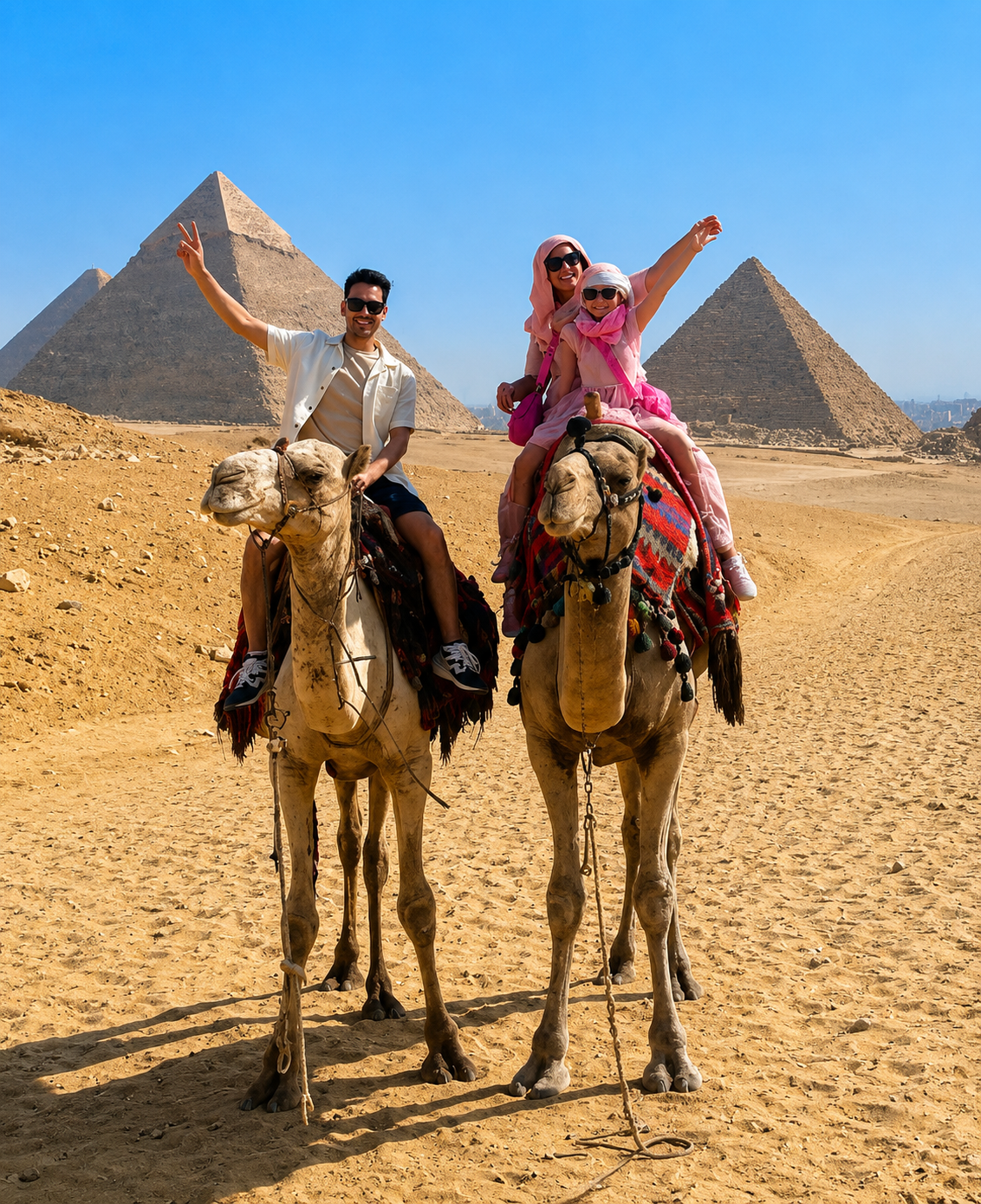
The Giza Pyramids are among the most recognizable monuments in the world and one of the greatest surviving achievements of ancient civilization. Located on the western edge of Cairo, the Giza Plateau attracts millions of travelers who come to see the monumental pyramids, the Great Sphinx, and the remains of one of ancient Egypt’s most important royal burial complexes.
For thousands of years, these extraordinary structures have inspired historians, archaeologists, architects, and travelers. Today, visiting the Giza Pyramids is an essential experience for anyone traveling to Egypt.
Where Are the Giza Pyramids?
The Giza Pyramids are located on the Giza Plateau, approximately 15 kilometers from central Cairo. Their location makes them easy to include in a Cairo sightseeing itinerary, whether you are staying in downtown Cairo, Giza, or near Cairo International Airport.
The plateau contains several important ancient monuments, but the three major pyramids are the most famous:
- The Great Pyramid of Khufu
- The Pyramid of Khafre
- The Pyramid of Menkaure
The complex also includes the Great Sphinx, temples, smaller pyramids, tombs, causeways, and other archaeological remains.
The Great Pyramid of Khufu
The Great Pyramid of Khufu is the largest of the three main pyramids and the most famous monument on the Giza Plateau. It was constructed during the Fourth Dynasty, around the 26th century BC, as the tomb of Pharaoh Khufu.
Originally, the pyramid was covered with smooth white limestone casing stones that would have reflected sunlight and made the monument appear bright and polished. Most of the outer casing has disappeared over the centuries, leaving the enormous limestone core visible today.
The Great Pyramid was originally approximately 146 meters high. Although it has lost some of its original height, it remains an extraordinary example of ancient engineering.
Visitors can admire the pyramid from outside or purchase an additional ticket to enter certain internal areas. The interior experience includes narrow passages and chambers and can be physically demanding, particularly during hot weather.
The Pyramid of Khafre
The Pyramid of Khafre is the second-largest pyramid at Giza and was built for Pharaoh Khafre, the son of Khufu.
Although it appears taller than the Great Pyramid from certain viewpoints, this is partly because it was constructed on higher ground. One of its most distinctive features is the remaining section of original limestone casing near the top.
The Pyramid of Khafre is closely associated with the Great Sphinx, which is believed to have been constructed during Khafre’s reign.
The Pyramid of Menkaure
The smallest of the three main pyramids is the Pyramid of Menkaure, built for Pharaoh Menkaure.
Despite being considerably smaller than the pyramids of Khufu and Khafre, Menkaure’s pyramid is an important part of the Giza complex. Its lower sections contain large granite blocks, demonstrating the enormous effort and resources required to construct royal monuments during ancient Egypt’s Old Kingdom.
The pyramid was surrounded by smaller pyramids and mortuary structures connected with the royal burial complex.
The Great Sphinx
No visit to Giza is complete without seeing the Great Sphinx. This enormous limestone statue has the body of a lion and the head of a human and is one of the most recognizable monuments of ancient Egypt.
The Sphinx is traditionally associated with Pharaoh Khafre, although researchers continue to study its construction, purpose, and historical context.
The monument represents the combination of human intelligence and the strength of a lion, reflecting ideas of royal power and protection in ancient Egyptian culture.
Visitors can view the Sphinx from several areas around the complex and enjoy excellent opportunities for photography.
Why Were the Pyramids Built?
The pyramids were primarily constructed as royal funerary monuments. Ancient Egyptians believed that death was a transition to another form of existence, and pharaohs required elaborate burial arrangements to support their journey into the afterlife.
The pyramid was part of a larger complex that could include temples, causeways, smaller pyramids, tombs, and other structures.
The scale of the Giza monuments demonstrates the power of the pharaohs and the highly organized society that supported their construction.
How Were the Pyramids Built?
One of the most fascinating questions surrounding the Giza Pyramids is how ancient Egyptians were able to construct such enormous monuments without modern machinery.
Archaeological evidence indicates that thousands of workers participated in the construction projects. Skilled craftsmen, engineers, stone workers, laborers, and other specialists were organized into teams.
Large limestone blocks were transported and positioned using systems that likely included sledges, ramps, ropes, levers, and coordinated human labor. The exact design and construction process remains an important subject of archaeological research.
What is clear is that the pyramids required extraordinary planning, mathematical knowledge, engineering skill, and logistical organization.
The Giza Pyramids and Ancient Egyptian Civilization
The pyramids are more than impressive structures. They provide an insight into the organization and beliefs of ancient Egyptian society.
Their construction required access to stone quarries, transportation systems, food supplies, housing, skilled labor, and centralized administration. The Giza Plateau therefore represents not only a collection of monuments but also evidence of the sophisticated civilization that created them.
Archaeologists have discovered workers’ settlements, cemeteries, tools, inscriptions, and other evidence that continues to improve our understanding of life during the Old Kingdom.
Best Time to Visit the Giza Pyramids
The cooler months from October to April are generally considered the most comfortable period for visiting the pyramids. Temperatures are usually more pleasant for walking and sightseeing.
If you visit during the warmer months, it is best to start early in the morning. Bring water, sunscreen, sunglasses, and comfortable walking shoes.
Early morning can also provide excellent conditions for photography, with softer light and generally fewer visitors.
How Long Do You Need at Giza?
Most visitors should allow approximately 3 to 4 hours to explore the main Giza Plateau comfortably. Travelers interested in spending more time taking photographs, entering a pyramid, visiting additional archaeological areas, or exploring at a slower pace may want to allow longer.
A professional Egyptologist guide can help you understand the history of each monument and organize the visit efficiently.
Tips for Visiting the Giza Pyramids
Wear comfortable shoes because the plateau involves walking over uneven surfaces. Carry bottled water and protect yourself from the sun.
If you plan to enter one of the pyramids, be prepared for narrow passages and potentially steep sections. Travelers who prefer not to enter can still enjoy spectacular views of the exterior monuments.
Respect the archaeological site by following designated paths and instructions from site staff.
It is also worth allowing time to enjoy panoramic viewpoints across the plateau. These locations offer some of the best opportunities to photograph all three major pyramids together.
Experience the Giza Pyramids with Let’s Explore Egypt Travel
The Giza Pyramids are a destination that combines history, architecture, archaeology, and unforgettable scenery. Standing in front of monuments built thousands of years ago provides a unique connection with one of humanity’s greatest ancient civilizations.
Whether you are visiting Egypt for the first time or returning to explore more deeply, the Giza Plateau deserves a place at the top of your itinerary.
With My Cairo Trips , you can discover the pyramids with private transportation and an experienced Egyptologist guide who can explain the history, stories, and significance behind these remarkable monuments.
From the Great Pyramid of Khufu to the mysterious Great Sphinx, the Giza Plateau offers an unforgettable journey into the heart of ancient Egypt.
Welcome to WordPress. This is your first post. Edit or delete it, then start writing!

Hi, this is a comment.
To get started with moderating, editing, and deleting comments, please visit the Comments screen in the dashboard.
Commenter avatars come from Gravatar.